Showing posts with label Math. Show all posts

Wednesday, August 4, 2021

Picture Book - 365 Penguins by Jean-Luc Fromental

Illustrated by Joelle Jolivet
Endpapers:  N/A - HUGE BOOK
2006 Harry N. Abrams, translated from French
44 huge, thick pages
Illustrations in Black, white, blue, and orange
Goodreads rating:   4.11 - 914 ratings
My rating:  5!

1st line/s:  "On New Year's Day, at nine o'clock in the morning, a delivery man rang our doorbell."

My comments:  Loved this book.  But, it's HUGE.  Not sure how I'm going to read it aloud! One penguin arrives each and every day for 365 straight days.  Lots of arithmetic and a few vocabulary words for younger readers (anonymous, three-digit-number, ecologist), one page where you hunt among the penguins for the only one with blue feet, and even a great poem:
    Penguins, penguins everywhere,
    Black and white and in my hair,
    Two or three would be quite nice,
    But hundreds more, let's think twice!
    Bathroom, bedroom, closet, kitchen --
    I've had enough, it's time to ditch 'em!
Goodreads:  From the amazing success of the documentary March of the Penguins to the popular penguins in Madagascar to this fall’s upcoming penguin-themed movie Happy Feet, penguins are everywhere! That’s especially true for the family in 365 Penguins, who find a penguin mysteriously delivered to their door every day for a year. At first they’re cute, but with every passing day, the penguins pile up—along with the family’s problems. Feeding, cleaning, and housing the penguins becomes a monumental task. They’re noisy and smelly, and they always hog the bathroom! And who on earth is sending these kwaking critters? In a large format, and with lots of opportunity for counting, 365 Penguins is sure to become a perennial wintertime favorite.

Friday, July 3, 2020

Poem - Take a Number by Mary O'Neill

I think this is an excerpt from the original full poem, it was taken from the book Marvelous Math, edited by Lee Bennett Hopkins,  It was written by Mary O'Neill.

from
Take a Number

Imagine a world
Without mathematics:

No rulers or scales,
No inches or feet,
No dates or numbers
On house or street,
No prices or weights,
No determining heights,
No hours running through
Days and nights.
No zero, no birthdays,
No way to subtract
All of the guesswork
Surrounding the fact.
No sizes for shoes,
Or suit or hat . . .
Wouldn’t it be awful
To live like that?

Saturday, July 28, 2018

PICTURE BOOK - Amanda Bean's Amazing Dream: A Mathematical Story by Cindy Neuschwander

Illustrated by Liza Woodruff
Math activities by Marilyn Burns
1998, Scholastic Press
for K - 3
available at Bosler Library N-bins
32 pgs.
Goodreads rating:  4.08 - 171 ratings
My rating:3.5
Endpapers:  rolling hills with helmeted sheep riding bicycles
Illustrations go from edge-of-page to edge-of-page.  Look like pen & ink drawings that heave been colored with water color.  Very nice, simple

1st line/s:  "I am Amanda Bean and I love math.  I know all about counting.  I am very good at it.  I can count by ones, twos, fives, and tens.  I can add up anything.  The kids at school call me Bean Counter."

My comments:  Simple book that introduces the concept of multiplying, that it is easier than adding or counting.  Excellent introduction.  Ends with three pages of activities/ideas to extend kids' learning about multiplication, but Marilyn Burns, mathematics idea guru extraordinaire.

Goodreads:  Amanda Bean loves to count everything, from the books in the library to the popcorn in her bowl. If only she could count faster! Her teacher tries to persuade her of the virtues of multiplication, but Amanda remains unconvinced--until she has an amazing dream. Full color

Thursday, June 21, 2018

56. Last Equation of Isaac Severy by Nora Jacobs

read on my iPhone
2018, Touchstone
337 pgs.
Adult mystery
Finished 6/21/18
Goodreads rating:  3.63 - 3205 ratings
My rating:  3.5
Setting: Contemporary LA

First line/s:   "On the morning he was to die, the old man woke early and set about making breakfast."

My comments:  An in-depth look at one screwed up family, The Last Equation of Isaac Severy comes at you from many directions.  Told distinctly from two different points of view and less distinctly from one or two others; mystery, reality of a gritty world, and some scientific/fantastic mathematics combine to make quite an interesting tale.

Goodreads synopsis: The Family Fang meets The Storied Life of A.J. Fikry in this literary mystery about a struggling bookseller whose recently deceased grandfather, a famed mathematician, left behind a dangerous equation for her to track down—and protect—before others can get their hands on it.
          Just days after mathematician and family patriarch Isaac Severy dies of an apparent suicide, his adopted granddaughter Hazel, owner of a struggling Seattle bookstore, receives a letter from him by mail. In it, Isaac alludes to a secretive organization that is after his final bombshell equation, and he charges Hazel with safely delivering it to a trusted colleague. But first, she must find where the equation is hidden.
          While in Los Angeles for Isaac’s funeral, Hazel realizes she’s not the only one searching for his life’s work, and that the equation’s implications have potentially disastrous consequences for the extended Severy family, a group of dysfunctional geniuses unmoored by the sudden death of their patriarch.
          As agents of an enigmatic company shadow Isaac’s favorite son—a theoretical physicist—and a long-lost cousin mysteriously reappears in Los Angeles, the equation slips further from Hazel’s grasp. She must unravel a series of maddening clues hidden by Isaac inside one of her favorite novels, drawing her ever closer to his mathematical treasure. But when her efforts fall short, she is forced to enlist the help of those with questionable motives.

Monday, December 4, 2017

PICTURE BOOK - Math at the Art Museum by Group Majoongmul

From the copyright page:  "Majoongmul is a Korean word that refers to "priming water" poured into a pump to start the flow before pumping water from a well.  Group Majoongmul is the name of the authors' group that creates books that serve as the priming water within children's hearts.
Illustrated by Yun-ju Kim
2015 TanTan Publishing - originally published in Korea
HC $16.95
32 nice, thick pgs.
Goodreads rating: 3.92 - 24 ratings
My rating: 4
Endpapers: Mottled cream

1st line/s: "My sister and I are going to the art museum with our parents!  'It's interesting that math can be found in art," Dad says.'"

My comments:  Many famous artists' work is represented in this art appreciation book for kids, each named and identified well.  At first I was a bit reluctant to see particular paintings included until I realized that point-of-view/perspective is, indeed, math.  Included are famous paintings by Jasper Johns, Seurat, Kandinsky, Leger, Picasso, Degas, Magritte, Matisse, and Dali, as well as two that I must learn more about: Giuseppe Arcimboldo and Kim Jae-hong.   The last five pages are informational and include activities for kids that combine art and math.

Goodreads:  This charming and colorful book incorporates mathematical concepts by introducing children to a fresh perspective on math through art
          When his father tells him there’s math in art, a young boy is suspicious of the idea. But when the boy explores paintings and other masterpieces with his sister and their parents, he begins to understand there is math in art, both hidden and visible. He sees, too, that math in art is brilliant—and beautiful! Hands-on activities and elementary mathematical concepts that relate to perspective, composition, symmetry, patterns, and other elements in artwork turn exploring art into an eye-opening adventure.

Monday, November 20, 2017

PICTURE BOOK - The Rabbit Problem by Emily Gravett

Illustrated by the author
2009 in England
2010 US McMillan Children's
HC $17.99
Goodreads rating:  4.24 - 760 ratings
My rating: 5 - This is going to be along-time favorite, I love it!
Back cover:  “The Rabbit Problem:  This book is based on a problem that was solved in the 13th Century by the Mathematician Fibonacci, but it is NOT (I repeat NOT) and book about math.  It is a book about rabbits… Lots of rabbits!”

My comments:  First of all, the book is made so you can SEE how it’s made, you can see the ¾-inch long stitches, you can see the four signatures, you can take a look at the spine and see how the book is put together.  For me, that’s cool.  Secondly, the book is made like a calendar.  Once you open to the first page you have to rotate the book and read it vertically.  There are even holes punched all the way through the book (including the cover) so that it could hang like a real calendar.  And then the cleverness starts.  So thirdly, each double-page spread has a small “something” attached that you have to read (and totally enjoy!) before you turn the page.  And fourthly (spoiler alert!!!):  the last two pages are a magnificent pop-up.
          An invitation; knitting directions; Bunny’s baby book; The Ministry of Carrots RATION BOOK (all filled in); “The Fibber”, Fibonacci Field’s only local newspaper; and the Carrot Cookbook are all totally delightful and hysterical.  Read every work, these are a riot.  Actually, the entire book is a riot.  Perfect for older kids and even adults for a good ha-ha-ha.
          And Fibonacci’s Principle is fully discovered, disclosed, and discussed.  There’s even a math problem involved if one desires to try to figure it out (I do!).  Every page bears details to delight one and all, so look carefully everywhere, and take your time.  What a treat!  Hugely recommended.

Goodreads:  Hop along to the Field and follow Lonely and Chalk Rabbit through a year as they try to cope with their fast expanding brood and handle a different seasonal challenge each month, from the cold of February to the wet of April and the heat of July.

Sunday, October 15, 2017

PICTURE BOOK - Lemonade in Winter: A Book About Two Kids Counting Money by Emily Jenkins

Illustrated by G. Brian Karas
2012, a Schwartz & Wae Book
32 pgs.
Goodreads rating:  3.68 - 595 ratings
My rating: 4
Endpapers:  solid pinky beige

1st line/s:   "An empty street.
                    Outside, a mean wind blows.
                    Icicles hang from the windowsills.

My comments:  Another math picture book, and it's cute.  The illustrations, by G. Brian Karas are fun to peruse.  A little girl and her younger brother decide to purchase ingredients, make lemonade (and limeade and lemon-limeade) and sell it outside in the blizzard.  There's all sorts of math having to do with quarters and how they add up, how much they spend, and how much they make.  They even have to come up with marketing and advertising ideas!  Nice for first and second ... and perhaps some third graders, too.


Goodreads:  In a starred review, Publishers Weekly declared this delightful picture book "a beautifully restrained tribute to trust and tenderness shared by siblings; an entrepreneurship how-to that celebrates the thrill of the marketplace without shying away from its cold realities; and a parable about persistence."  
          A lemonade stand in winter? Yes, that's exactly what Pauline and John-John intend to have, selling lemonade and limeade--and also lemon-limeade. With a catchy refrain (Lemon lemon LIME, Lemon LIMEADE! Lemon lemon LIME, Lemon LEMONADE!), plus simple math concepts throughout, here is a read-aloud that's great for storytime and classroom use, and is sure to be a hit among the legions of Jenkins and Karas fans. 

Thursday, September 14, 2017

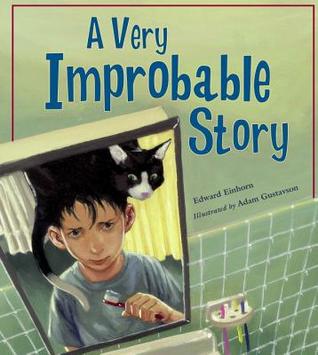
PICTURE BOOK - A Very Improbable Story by Edward Einhorn

Illustrated by Adam Gustavson
2008, Charlesbridge
HC $16.95
32 pgs.
Goodreads rating:  3.99 - 94 ratings
My rating:  4
Endpapers: Dark blue
Illustrations on much or most of page, text is on white
1st line/s:  "one morning Ethan woke up with a cat on his head."

My comments:   Oh my gosh, what a great picture book to introduce probability to older kids!  It's cute and fun and gives wonderful mathematical information in a straight-forward, interesting way.  It gets a little convoluted at the end, but if it's being used as a read aloud, stress and pausing  can be used  effectively, and then play a probability game similar to one described in the book and VOILA!!


Goodreads:  Ethan wakes up one morning with a talking cat on his head. The cat refuses to budge until Ethan wins a game of probability. Without looking, Ethan must pick out a dime from his coin collection, or two matching socks from his dresser, or do something else improbable. Avery improbable story about a challenging math concept. Author: Edward Einhorn Format: 32 pages, paperback Ages: 7-10

Monday, September 11, 2017

PICTURE BOOK - Lines, Bars and Circles: How William Playfair Invented Graphs by Helaine Becker

Illustrated by Marie-Eve Tremblay
2017 Kids Can Press
36 pgs.(yes, I counted twice)
Goodreads rating: 3.85 - 54 ratings
My rating:  4
Endpapers: Solid light yellowish-brown

1st line/s:  "William Playfair was a dreamer.  He saw the world differently than other people."

My comments:  William Playfair (don't you love the name?) was, well, a goof-off and loser.  He was a great thinker with great ideas, but most of them fell through or got him in trouble.  And although he was the first recorded person to create and use line charts, bar graphs, and pie graphs, they were more-or-less scoffed at during his lifetime.  Poor guy.  This book chronicles all his failings and some of his triumphs, giving us a glimpse into the times as well - historical information is presented within the book (not as an afterword) on The Scientific Method, The Industrial Revolution, and The French Revolution. There IS also a three- page afterword with more information about the charts that Mr. Playfair actually created.

Goodreads:   Born in Scotland more than 250 years ago, William Playfair was a dreamer who ?saw the world differently from other people.? Unfortunately, this difference sometimes got in the way of his success. Early on, as he attempted to apply his unique perspective to a series of career opportunities in order to gain ?riches! fame! glory!? he instead suffered one failure after another. Then, while writing a book about economics, Will's innovative vision inspired an idea that would set him apart: he created the first modern line graph. Next came a bar graph and later a pie chart. These infographic inventions provided a way for numbers to be seen as pictures, which made them easier to understand and to remember --- and thus changed the way the world would interact with data forever.
          With this story of an unconventional man whose creative expressions revolved around math, science, engineering and technology, bestselling author Helaine Becker has created the perfect picture book introduction to STEM education. It would easily find use across curriculums in the classroom. On one level, it is a well-told and engaging biography of an intriguing man, illustrated with humor by Marie-Ève Tremblay. But it also explores math concepts such as measurement and geometry, as well as history, with sidebars on subjects such as the Industrial Revolution and steam engines. In addition, the book teaches the important lesson that everyone should follow their own curiosities to wherever they lead. The end matter includes historical notes, as well as more detailed explanations of the three types of graphs.

Saturday, September 9, 2017

PICTURE BOOK - Infinity and Me by Kate Hosford

Illustrated by Gabi Swiatkowska
2012, Carolrhoda Books, Minneapolis (a division of Lerner Books)
32 pgs.
Goodreads rating: 3.99 - 814 rtings
My rating: 4
Endpapers endless numbers black on gray

1st line/s:  "The night I got my new red shoes, I couldn't wait to wear them to school."

My comments:  Infinity has always been a tough concept for me to wrap my mind around.  In this book, a little girl inquires of different people what they think of when they think of infinity.  The illustrations are really interesting and different.  I'm planning to use this book as the perfect  introduction to a quick program for kids that's an inquiry about infinity.


Goodreads:   When I looked up, I shivered. How many stars were in the sky? A million? A billion? Maybe the number was as big as infinity. I started to feel very, very small. How could I even think about something as big as infinity? Uma can't help feeling small when she peers up at the night sky. She begins to wonder about infinity. Is infinity a number that grows forever? Is it an endless racetrack? Could infinity be in an ice cream cone? Uma soon finds that the ways to think about this big idea may just be . . . infinite.

Friday, July 26, 2013

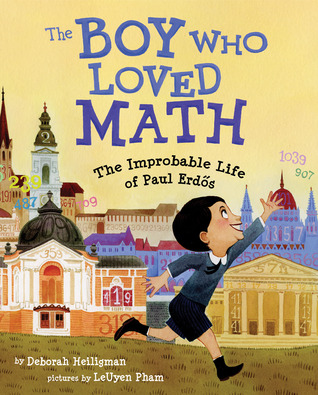
The Boy Who Loved Math - Deborah Heiligman

The Improbable Life of Paul Erdos
illustrated by LeUyen Pham
Roaring Brook Press, 2013
HC$17.99
Ellsworth Library 
40 pages
Goodreads rating: 4.46
My rating: 5 - Awesome book on many counts
Endpapers: prime numbers on a greeny/brown
Title Page:  Double pages, the same greeny/brown with 4 Erdos-as-a-kid, writing those prime numbers...
Illustrations:  Colorful, fun, the actual NUMBER (8, 1, 2....) incorporated as often as possible.

1st line:  "There once was a boy who loved math.  He grew up to be 1 of the greatest mathematicians who ever lived.  And it all started with a big problem..." 

My reaction:  What an incredibly fascinating person. I'm so glad I've found some picture book biographies that lessen my ... dislike ... of nonfiction, and that someone had the insight to write about Paul Erdos. The books and illustrations complement each other in such a way that it seems like one person might have created a book on her own. And Erdos (AIR-dish) was ultra-interesting. Especially to a math lover (me). Prime numbers, the sieve of Eratosthenes, and my new favorite discovery:(Erdos's, actually), that there is always another prime number between a prime number and its double. Fascinating, interesting, and fun! I will definitely be purchasing this book for my classroom to use both with my author studies AND math.

Goodreads:  "Most people think of mathematicians as solitary, working away in isolation. And, it's true, many of them do. But Paul Erdos never followed the usual path. At the age of four, he could ask you when you were born and then calculate the number of seconds you had been alive in his head. But he didn't learn to butter his own bread until he turned twenty. Instead, he traveled around the world, from one mathematician to the next, collaborating on an astonishing number of publications. With a simple, lyrical text and richly layered illustrations, this is a beautiful introduction to the world of math and a fascinating look at the unique character traits that made "Uncle Paul" a great man."