Showing posts with label Trees. Show all posts

Thursday, July 8, 2021

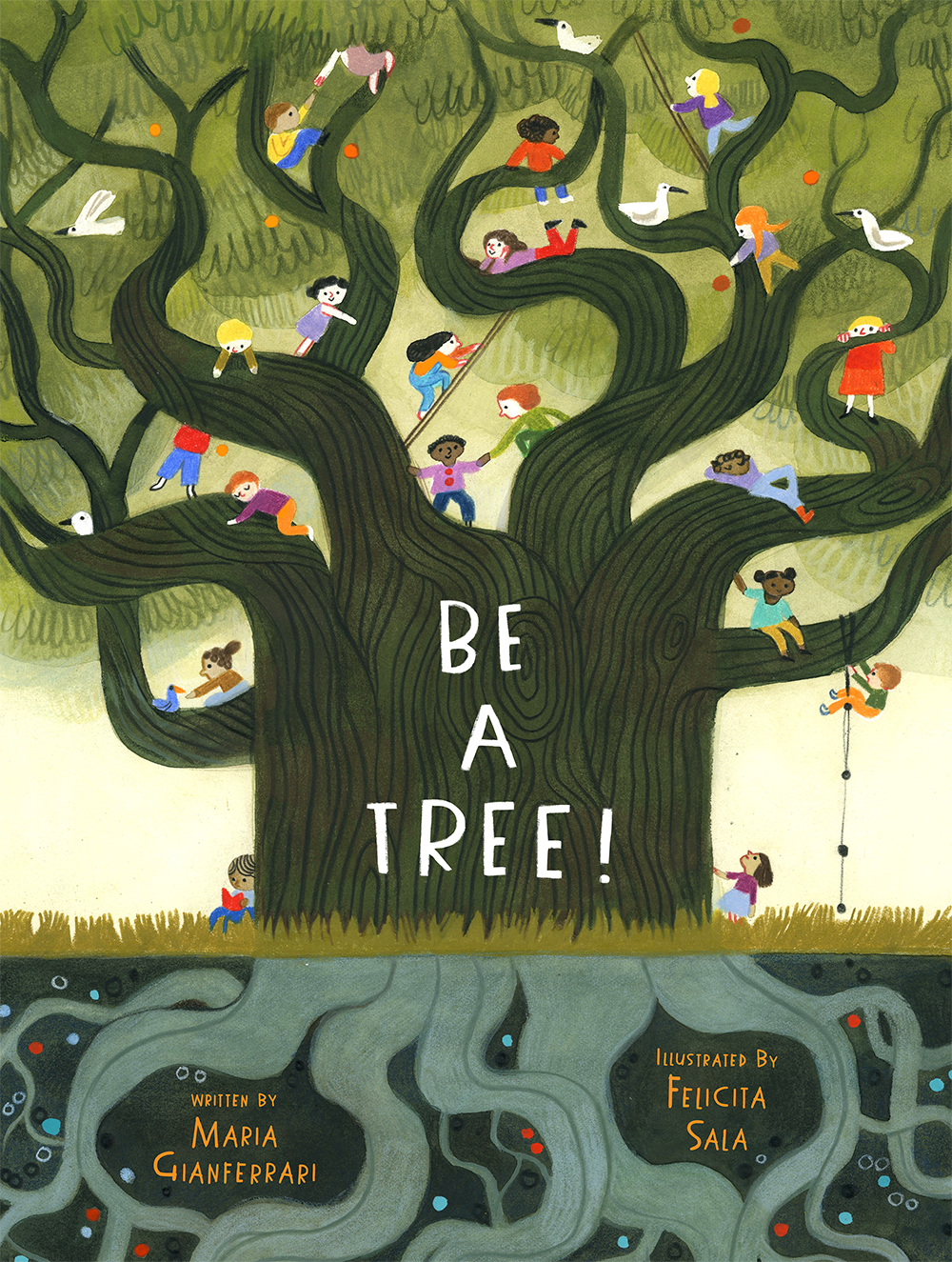
Picture Book - Be a Tree! by Maria Gianferrari

Illustrated by Felicita Sola
found at Ellsworth Public Library, 7/8/2021
2021 Abrams Books for Young Readers
44 pgs. including two that fold out into a huge quadrapage spread
Goodreads rating:  4.10 - 192 ratings 
My rating:  5
Endpapers:  3 shades of green, simple outlines of different leaves, labelled, showing veins

1st line/s:  "Be a tree!"

My comments:  Trees are special.  Trees are friends.  And this book compares them to people and communities.  Great vocabulary, cool illustrations, wonderful tress of all sorts and locales are depicted.  "So be a tree.  For together, we are a forest."  A zillion applications for the classroom.
    Vocabulary:  sapwood (xylem, carries water & nutrients from the roots), heartwood (dead wood in the tree's center, gives strength and support), pith (soft tissue found in the very center of trunk, holds key nutrients as sapling grows, then dries up as the tree ages), sapling, crown, alert, fungi, purify, doe, sustain, vulnerable, cosmos. Also:  WOOD wide web (cute!) and Immigrant Trees.
    Activity Idea:  Leaf project of some sort
    Ends with an Author's note  - 5 ways you can save trees - How you can help your community - Anatomy of a tree - Further reading and websites
    fantasticfunandlearning.com/tree-activities-for-kids.html
    neefusa.org/nature/land/tree-toolkit
    theteachersguide.com/arbordaylessonplans.htm
    earthday.org/campaign/the-canopy-project
    arborday.org/celebrate

Goodreads:  An illustrated look at the majesty of trees—and what humans can learn from them.
Stand tall.
Stretch your branches to the sun.
Be a tree!

We are all like trees: our spines, trunks; our skin, bark; our hearts giving us strength and support, like heartwood. We are fueled by air and sun.
And, like humans, trees are social. They “talk” to spread information; they share food and resources. They shelter and take care of one another. They are stronger together.

Thursday, April 22, 2021

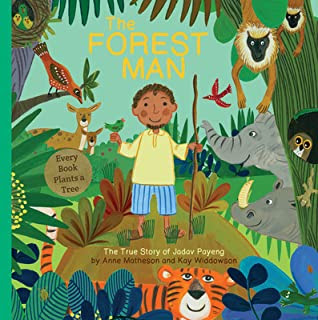
Picture Book - The Forest Man: The True Story of Jadav Payeng by Anne Matheson

Illustrated by Kay Widdowson 
found at Amelia Givin Library
2020 FlowerPot Press
32 pgs.
Goodreads rating:  3.80 - 60 ratings
My rating:  4
Endpapers:  Simple.  White with one-inch yellow grid lines.

1st line/s:  "Jadev Payeng loves trees."

My comments:  Someone called this "a treat for the eyes" and I agree.  How one person took two hours traveling back and forth for forty years to replant and recreate a decimated forest island in India.  The last six pages told of animals, easy-to-follow further facts, and a great glossary.  Perfect for younger classes learning about biomes, or for any age that cares about making the world a better place, and growing trees.
Jadav Payeng

Goodreads:  After years of harsh monsoon seasons, a forest on the river island of Majuli is in danger of being slowly washed away. Jadav, a boy living on the island, is determined to save the forest he loves.
          This is the true story of how one young boy dedicated his life to creating and cultivating an expansive forest that continues to grow to this day. In a world impacted by climate change, Jadav Payeng's inspirational story shows how one person's contributions can make a difference in helping to save our environment.
          Featuring a beautiful arlin paper cover with foil text enhancements and educational back matter including a glossary, fun facts, and resources for further reading, this book introduces a new understanding of our planet and encourages mindfulness and action when it comes to caring for the environment.
          In partnership with Trees for the Future (TREES), each book sold plants a tree.

Sunday, June 28, 2020

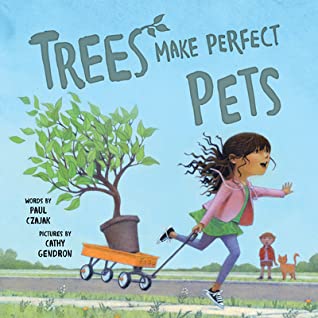
Picture Book - Trees Make Perfect Pets by Paul Czajak

Illustrated by Cathy Gendron
2020 Sourcebooks/Jabberwocky
HC 17.99
32 pgs.
Goodreads rating:  4.19 - 48 ratings
My rating:  4.5
Endpapers: mossy green

1st line/s:  "Birthdays are the best days for wishes and on this birthday Abigail wished for a pet."

Dedications:  To Abigail:  Yes, We'll get a dogwood, but you have to name it. - PC
     To green thumbs everywhere - CG

My comments:  I love trees, so I quickly and happily pick up every new book I find that has something to do with them.  This one was adorable, both the premise, the setting, and the illustrations.  This particular tree did seem to grow particularly quickly, but it's a picture book, right?


Goodreads:  Abigail is determined to get the perfect pet.
          So she chooses Fido. He keeps her cool from the sun, stays where she tells him, and even gives her air to breathe. That's because Fido is a tree!
          But not everyone thinks having a tree as a pet is a good idea, though, especially when Fido starts to grow. Will Abigail be able to keep her perfect pet?

Tuesday, February 18, 2020

Picture Book - The Universe is a Tree by Laura Filippucci

Illustrated by the author
2018, Creative Editions
HC $ 18.99
32 pgs.
Goodreads rating:  3.90 - 10 ratings
My rating:  5
Endpapers:  a beautifully drawn tree in greens on white, with two poems/quotes:  one fby Charles Darwin, the other from Katha Upanishad.

My comments:   Oh my gosh, I love this book.  I love trees.  I love short, clear poetry and meaningful quotes.  So both of those are covered really well...and the illustrations are glorious!  The short explanation about each of the trees is interesting and readable, so that you can read the entire book without skimming.  Hoorah!  I wish I could have the opportunity to see them all.  I think I'll start a buck list based on these trees...

Redwood (Trees are Creators)
Kauri (Trees are Ancestors)
Oak (Trees are Temples)
Cedar of Lebanon (Trees are Homes of the Gods)
Yew (Trees are Gates to the Beyond)
Kapok (Trees are Channels to Other Worlds)
Baobab (Trees are Givers)
Sweet Chestnut (Trees are Protection)
Olive (Trees are Bearers of Peace)
Ginkgo (Trees are Healers)
Banyan/Bodhi (Trees are Founts of Wisdom)
Bristlecone Pine (Trees are Keepers of Secrets)

"To be like these, straight, true and fine,
to make our world like theirs, a shrine;
Sink down, Oh, traveler, on your knees,
God stands before you in these trees.
          -Joseph B. Strauss, from "The Redwoods"
NOTE:  This is MY kind of god!

GoodreadsTrees are teachers, healers, protectors, creators. They keep secrets. They bring peace. This rich anthology of stories, proverbs, and poems about trees from around the world reveals that a tree's roots not only go down deep into the earth, but its branches also reach up and out into the universe, connecting us all, across time and space. May we peer through the forests of our imaginations to see the beauty and experience the awe that still arches over our world.

Sunday, July 28, 2019

Poetry Picture Book - Winter Bees & Other Poems of the Cold by Joyce Sidman

Illustrated by Rick Allen
2014 Houghton Mifflin Harcoart
HC $17.99
32 pgs.
Goodreads rating:  4.24 -  1179 ratings
My rating:  5
Endpapers: Solid purplish-gray

My comments:  There are twelve lovely poems in this collection, and each of them has a qualifying, informative explanation in prose (example follows).   Very nice for the winter-hater and poetry-lover in me!

Goodreads:  In this outstanding picture book collection of poems by Newbery Honor-winning poet, Joyce Sidman (Song of the Water Boatman,Dark Emperor and Other Poems of the Night)discover how animals stay alive in the wintertime and learn about their secret lives happening under the snow. Paired with stunning linoleum print illustrations by Rick Allen, that celebrate nature's beauty and power.

What Do the Trees Know?

What do the trees know?
          To bend when all the wild winds blow.
          Roots are deep and time is slow.
          All we grasp we must let go.
What do the trees know?
          Buds can weather ice and snow.
          Dark gives way to sunlight's glow.
          Strength and stillness help us grow.

"Trees, the giants of the plant world, survive winter in two very different ways.  Coniferous (evergreen) trees have thin, was-covered needles that tolerate freezing temperatures and remain on the tree all year round.  Deciduous (leafy) trees, on the other hand, sprout large, flat leaves every spring that are perfect for gathering sunlight to produce energy.  Deciduous trees grow like mad while the weather is warm, but in winter they essentially shut down.   They shed their luxuriant leaves, which would freeze anyway and suck much-needed water from the tree.  The tiny buds, which will hold next year's leaves, develop a tough, scaly coating to protect them all winter.  As the temperatures drop, the living tissue in the tree's trunk undergoes a process called hardening, in which cells lose water and become more resistant to freezing.  An early cold snap - before a tree has hardened - will damage its branches.  But after hardening, the tree will spend the winter months dry, cold, and protected - waiting for spring to swell those hardy buds."

Tuesday, July 10, 2018

PICTURE BOOK - Wangari Maathai: The Woman Who Planted Millions of Trees by Franck Prevot

Illustrated by Aurelia Fronty
2015 Charlesbridge Publishing
HC $17.99
40 pgs.
Goodreads rating:  4.28 - 414 ratings
My rating:  5
Endpapers"  Deep, sleek plum
1st line/s:  "The immense forest around Wangari's childhood home is populated by bongo antelopes, monkeys, and butterflies."

My comments:  Woah, I've read five picture books about Wangari Maathai, but this is the one that's jam-packed with information for older readers, instead of just mentioning things, fleshing them out a little more.  We learn HOW she got to the US for college, HOW she protested, and WHY she ended up in prison.  Wonderful book, perfect to use with 4th, 5th, 6th graders studying the environment, making a difference in the world, activism, trees, Tu'Bshvat,......

Read the Text


Goodreads:  Wangari Maathai received the Nobel Peace Prize in 2004 for her efforts to lead women in a nonviolent struggle to bring peace and democracy to Africa through its reforestation. Her organization planted over thirty million trees in thirty years. This beautiful picture book tells the story of an amazing woman and an inspiring idea.

Monday, January 15, 2018

Text for Planting the Trees of Kenya by Claire A. Nivola


Planting the Trees of Kenya: The Story of Wangari Maathai by Claire A. Nivola

     As Wangari Maathai tells it, when she was growing up on a farm in the hills of central Kenya, the earth was clothed in its dress of green.

     Fig trees, olive trees, crotons, and flame trees covered the land, and fish filled the pure waters of the streams. 

     The fig tree was sacred then, and Wangari knew not to disturb it, not even to carry its fallen branches home for firewood.  In the stream near her homestead where she went to collect water for her mother, she played with glistening flogs’ eggs, trying to gather them like beads into necklaces, though they slipped through her fingers back into the clear water.

     Her heart was filled with the beauty of her native Kenya when she left to attend a college run by Benedictine nuns in America, far, far from her home.  There she studied biology, the science of living things.  It was an inspiring time for Wangari.  The students in America in those years dreamed of making the world better.  The nuns, too, taught Wangari to think not just of herself but of the world beyond herself.
     How eagerly she returned to Kenya!  How full of hope and of all that she had learned!

She had been away for five years, only five years, but they might have been twenty – so changed was the landscape of Kenya.
     Wangari found the fig tree cut down, the little stream dried up, and no trace of frogs, tadpoles, or the silvery beads of eggs.  Where once there had been little farms growing what each family needed to live on and large plantations growing tea for import, now almost all the farms were growing crops to sell.  Wangari noticed that the people no longer grew what they ate but bought food from stores.  The store food was expensive, and the little they could afford was not as good for them as what they had grown themselves, so that children, even grownups, were weaker and often sickly.   

     She saw that where once there had been richly wooded hills with grazing cows and goats, now the land was almost treeless, the woods gone.  So many trees had been cut down to clear the way for more farms that women and children had to walk farther and farther in search of firewood to heat a pot or warm the house.  Sometimes they walked for hours before they found a tree or bush to cut down.  There were fewer and fewer trees with each one they cut, and much of the land was as bare as a desert.

     Without trees there were no roots to hold the soil in place.  Without trees there was no shade.  The rich topsoil dried to dust, and the “devil wind” blew it away.  Rain washed the loose earth into the once-clear streams and rivers, dirtying them with silt.

     “We have no clean drinking water,”  The women of the countryside complained, “no firewood to cook with.  Our goats and cows have nothing to graze on, so they make little milk.  Our children are hungry and we are poorer than before.”
     Wangari saw that the people who had once honored fig trees and now cut them down had forgotten to care for the land that fed them.  Now the land, weak and suffering, could no longer take care of the people, and their lives became harder than ever.
     The women blamed others, they blamed the government, but Wangari was not one to complain.  She wanted to do something.  “Think of what we ourselves are doing,” she urged the women.  “We are cutting down the trees of Kenya.
     “When we see that we are part of the problem,” she said, “we can become part of the solution.”
     She had a simple and big idea.

     “Why not plant trees?”  she asked the women.
     She showed them how to collect tree seeds from the trees that remained.  She taught them to prepare the soil, mixing it with manure.  She showed them how to wet that soil, press a hole in it with a stick, and carefully insert a seed.  Most of all she taught them to tend the growing seedlings, as if they were babies, watering them twice a day to make sure they grew strong.

     It wasn’t easy.  Water was always hard to come by.  Often the women had to dig a deep hole by hand and climb into it to haul heavy bucketfuls of water up over their heads and back out of the hole.  An early nursery in Wangari’s backyard failed; almost all the seedlings died.  But Wangari was not one to give up, and she showed others how not to give up.

     Many of the women could not read or write.  They were mothers and farmers, and no one took them seriously.

     But they did not need schooling to plant trees.  They did not have to wait for the government to help them.  They could begin to change their own lives.

     All this was heavy work, but the women felt proud.  Slowly, all around them, they could begin to see the fruit of the work of their hands.  The woods were growing up again.  Now when they cut down a tree, they planted two it its place.  Their families were healthier, eating from the fruit trees they had planted and from the vegetable plots filled again with the yams, cassava, pigeon peas, and sorghum that grew so well.  They had work to do, and the work brought them together as one, like the trees growing together on the newly wooded hills.
     The men saw what their wives, mothers, and daughters were doing and admired them and even joined in. 
  
     Wangari gave seedlings to the schools and taught the children how to make their own nurseries. 

     She gave seedlings to inmates of prisons and even to soldiers.  “You hold your gun,” she told the soldiers, “but what are you protecting?  The whole country is disappearing with the wind and wter.  You should hold the gun in your right hand and a tree seedling in your left.  That’s when you become a good soldier.”

     And so in the thirty years since Wangari began her movement, tree by tree, person by person, thirty million trees have been planted in Kenya—and the planting has not stopped.

     “When the soil is exposed,”  Wangari tells us,  “it is crying out for help, it is naked and needs to bec clothed in its dress.  That is the nature of the land.  It needs color, it needs its cloth of green.”

Plus Author’s Note
Tuesday, October 24, 2017

PICTURE BOOK - Grandfather's Christmas Tree by Keith Strand

Illustrated by Thomas Locker
1999, Silver Whistle, Harcourt Brace & Co.
Looks to be out of print
32 pgs.
Goodreads rating:  4.06 * 35 ratings
My rating:  4
Endpapers:  Evergreen with gray fir sprills.
1st line/s:  "My mother and father came to Colorado in May of 1886."

My comments:  Thomas Locker's illustrations drew me this book...and the story, though long-ish for a picture book, is simple.  It tells how a family tradition (placing a hand-carved set of geese into the boughs of their huge outdoor spruce) of this Colorado family began.  It's not about Christmas, or gifts, it's about survival and family love.

Goodreads:  Beginning their life together in the Colorado wilderness, a young rancher and his wife work hard, and joyfully anticipate the birth of their first child. Their many hopes and dreams for their new family are suddenly put in danger when a merciless winter storm hits. The logs in the woodpile quickly dwindle, and soon their only chance for survival is to cut down the lone remaining spruce tree, which provides warmth and shelter to a family of geese--a family not unlike their own. On Christmas Eve the couple prays for a miracle that will protect them and their newborn son. Thomas Locker's glorious paintings and Keith Strand's inspiring reverie bring the Christmas spirit to life in this heartwarming story of faith and family.

Thursday, March 23, 2017

PICTURE BOOK - The Great Spruce by John Duvall

Illustrated by Rebecca Gibbon
2016, GP Putnams Sons
32 pgs.
Goodreads rating:  3.72 (122 ratings)
My rating:  4
Endpapers:  FRONT:  Pineforest green with sprills, bugs, owls, birds, and even a mouse and a snail scattered across the page.
BACK:  Same pine forest green with sprills, but with ornaments instead of fauna.  Clever!
Illustrations

My comments:  I have, in recent years, fretted quite a bit about the huge coniferous tree that has been cut each year to adorn Rockefeller Center at Christmastime.  This well-written book gives a grand message about ecology without being preachy.  Cleverly done, Mr. Duvall!  I loved the illustrations, they reminded me of some of the Golden Books I read as a child.  Not just for Christmas, but for the whole year through.

Goodreads:  Together with his grandpa, a young boy finds a way to save his favorite tree in this heartwarming Christmas tale
           Alec loves to climb trees—the little apple trees, the wide willow trees, even the tall locust trees. But his favorite is the great spruce, with its sturdy trunk and branches that stretch up to the sky. Alec’s grandpa planted it as a sapling years and years before Alec was born, and every Christmas, Alec and his grandpa decorate the tree together, weaving tinsel and lights through its branches, making it shine bright.
           But one day, a few curious men from the nearby city take notice of Alec’s glistening great spruce, and ask to take it away for their Christmas celebration. Though it’s a huge honor, Alec’s heartbroken at the idea of losing his friend. With great courage and creativity, Alec comes up with a plan to save his favorite tree in this joyful holiday tale.

Friday, June 17, 2016

PICTURE BOOK - The Night Gardener by the Fan Brothers

Terry Fan and Eric Fan
2016, Simon & Schuster Books for Young Readers
$17.99
 40 pgs.
Goodreads rating: 4.02 (2,009 ratings)
My rating: 5
Endpapers lovely pencil-drawn leafy branches on green
Illustrations:  Intricate pencil drawings, some colored, some not.  WINNERS!
1st line/s: "William looked out his window to find a commotion on the street."

My comments: Opening to the first double page spread, I knew this book would be a winner.  Somehow the illustration reminded me of the illustrations in Homer Price, which brought back wonderful memories. I was not disappointed.  Although there is a short, pleasing narrative, this could easily be a wordless book.  It's delightful!

Goodreads:  One day, William discovers that the tree outside his window has been sculpted into a wise owl. In the following days, more topiaries appear, and each one is more beautiful than the last. Soon, William’s gray little town is full of color and life. And though the mysterious night gardener disappears as suddenly as he appeared, William—and his town—are changed forever.

Sunday, October 5, 2014

PICTURE BOOK - As An Oak Tree Grows - G. Brian Karas

Illustrated by the author
2014 Nancy Paulsen Books, Penguin
HC $17.99
32 oversized pages with POSTER IN A POCKET IN THE BACK
Goodreads rating: 3.90
My rating: 4.5 (It would have been a five if it had started a little more honestly....see below.....)
Endpapers:the palest of green, with the same darker green leaves and acorns.  gentle.
Title Page:  Most of the page is taken up with a huge tree truck.  Beside it sits an acorn.  The only other thing you see is a huge field of grass.
Illustrations: Gouache and pencil.  Goergeous.  Covering the entire page.  I wonder what size the actual drawings are?
1st line/s: "On a sunny late summer day, a young boy planted an acorn in the ground."

"In Memory of Pete Seeger" (How wonderfully lovely!)


My comments:  Okay, I agree that this book starts out a little...well, a lot... shakily, but other than that the concept and the illustrations are wonderful.  (Let's be honest, the young Native American boy didn't just grow up and move away.) But the story had to start somewhere, and the progression of PROGRESS (good OR bad) and GROWTH IN NATURE are beautifully depicted.  The time line across the bottom is a wonderful plus, the 25-year increments work perfectly, and of course, it ended the only way it could (what happens to a huge 225-year-old-tree).  I LOVED pouring over each picture looking for the changes.  I love, too, that the scene was shown in different weather and at different times of the day.

Goodreads: This inventive picture book relays the events of two hundred years from the unique perspective of a magnificent oak tree, showing how much the world can transform from a single vantage point. From 1775 to the present day, this fascinating framing device lets readers watch as human and animal populations shift and the landscape transitions from country to city. Methods of transportation, communication and energy use progress rapidly while other things hardly seem to change at all.
           This engaging, eye-opening window into history is perfect for budding historians and nature enthusiasts alike, and the time-lapse quality of the detail-packed illustrations will draw readers in as they pore over each spread to spot the changes that come with each new era. A fact-filled poster is included to add to the fun.

Sunday, June 8, 2014

PICTURE BOOK - Maple - Lori Nichols

Illustrated by the author
2014 Nancy Paulsen Books/Penguin
HC $16.99
32 pages
Goodreads rating: 4.25
My rating: 4/Delightful
Endpapers:  pale lime green with pale white drawings of leaves, trowels, watering cans, sprouts; rear end papers the same except light blue
Title Page: single page, facing white; top and bottom large maple leaves, title in cursive brown.
Illustrations: "Pencil on mylar, then digitally colored."  The girl's face is nicely expressive.
1st line: Maple loved her name.  When she was still a whisper, her parents planted a tiny tree in her honor!"

My comments:  I was looking for new picture books at the library and grabbed this one for two reasons - I love books about tress, and because all the others appeared to be anthropomorphic...which aren't my favorites.  It was really cute, and quite joyous.  And - it's a wonderful book for a child that's about to have a new baby join the family.

Goodreads:  Lori Nichols’ enchanting debut features an irresistible, free-spirited, nature-loving little girl who greets the changing seasons and a new sibling with arms wide open.
          When Maple is tiny, her parents plant a maple tree in her honor. She and her tree grow up together, and even though a tree doesn’t always make an ideal playmate, it doesn’t mind when Maple is in the mood to be loud—which is often. Then Maple becomes a big sister, and finds that babies have their loud days, too. Fortunately, Maple and her beloved tree know just what the baby needs.

Wednesday, January 23, 2013

Poems and Books About TREES

Picture Books About Trees:

Chin, Jason - Redwoods
Duval, John:  The Great Spruce
Fan Brothers:  The Night Gardener
Filippucci, Laura:  The Universe is a Tree
Formento, Alison - The Tree Counts
Gerber,Carole - Winter Trees
Gourley, Robbin - Bring Me Some Apples and I'll Bake You a Pie
Jackson, Alison - Thea's Tree
Karas, G. Brian:  As an Oak Tree Grows
Mora, Pat - Pablo's Tree
Muldrow, Diane - We Planted a Tree
Nichols, Lauri - Maple
Nivola, Claire A.:  Planting the Trees of Kenya
Pallotta, Jerry - Who Will Plant a Tree?
Prevot, Franck:  Wangari Maathai:  The Woman Who Planted Millions of Trees
Rex, Adam - Tree Ring Circus
Roth, Susan L. & Trumbore, Cindy - The Mangrove Tree
Strand, Kieth:  Grandfather's Christmas Tree
Thong, Roseanne - The Wishing Tree
Winter, Jeanette - Wangari's Tree of Peace
Worth, Bonnie - I Can Name 50 Trees Today


Tu b'Shvat

Tu b'Shvat is one of the "new year" celebrations in the Jewish culture. In short, it's a celebration of trees.  As a non-Jew, this is one of my favorite Jewish celebrations (since I work in a Jewish day school, I do get to "celebrate" most Jewish holidays and holy days). This year, Tu b'Shvat falls on January 26th.  Here are some of my favorite poems that have to do with trees...old poems and newish poems.

Trees

The Oak is called the king of trees,
The Aspen quivers in the breeze,
The Poplar grows up straight and tall,
The Peach tree spreads along the wall,
The Sycamore gives pleasant shade,
The Willow droops in watery glade,
The Fir tree useful in timber gives,
The Beech amid the forest lives.
       Sarah Coleridge


Evergreen

Hemlock and pine
stand in July
grassy steeples
against the sky.

Sequoia and yew
October days short
green shadows lengthen
over the court.

Spruce and cypress
December winds blow
emerald palaces
shining in snow.

Cedar and fir
March freshets and rains
whatever the season
green remains

Juniper conifer constancy
evergreen evergreen evergreen grow
evergreen evergreen ever green grow.
       Eve Merriam


The Tree on the Corner


I’ve seen

the tree on the corner

in spring bud

and summer green.


Yesterday

it was yellow gold.

Then a cold
wind began to blow.

Now I know ---
you really do not see
a tree
until you see
its bones.
Lilian Moore

In Hardwood Groves

The same leaves over and over again!
They fall from giving shade above.
To make one texture of faded brown.
And fit the earth like a leather glove.
Before the leaves can mount again
To fill the trees with another shade,
They must go down past things coming up.
They must go down into the dark decayed.
They must be pierced by flowers and put
Beneath the feet of dancing flowers.
However it is in some other world
I know that this is the way in ours.
       Robert Frost


TREES

THINK that I shall never see
A poem lovely as a tree.
A tree whose hungry mouth is prest
Against the earth's sweet flowing breast;
A tree that looks at God all day,
And lifts her leafy arms to pray;
A tree that may in Summer wear
A nest of robins in her hair;
Upon whose bosom snow has lain;
Who intimately lives with rain.
Poems are made by fools like me,
But only God can make a tree.
        Joyce Kilmer

The Leaves Fall Down

One by one the leaves fall down
From the sky come falling one by one
And leaf by leaf the summer is done
One by one by one by one.
Margaret Wise Brown

Leaves

In spring,
yellow-green and tiny,
you pop out and dress big trees
in baby clothes.
You grow bigger and greener
in different shapes and styles
for different kinds of trees.
You flutter in the breeze like flats
and whisper, "Shhhhhhh.
Listen to the world."
You turn your backs to storms,
flash and sparkle in the sun,
and for Halloween
you wear costumes!
Some dress as flames or grapes,
some as orranges or gold coins.
And when the wind ocmes for you,
you let go of the branches
and fly, whirling in flocks
with the sparrows
till you drift
exhausted
to the ground
like a blanket of colorful,
crispy cornflakes,
and we rake you up,
and leap into you ---
you're all we have left of summer.
But don't forget!
Come back
next spring.

     ~Mordicai Gerstein
       from Dear Hot Dog

Tree Song

Roots,
trunk,
branches,
leaves.
As a tree
gives
so it
receives:
food
from
the earth,
rain
and sun
from 
the sky.
Its roots
reach
deep
and its crown
rises
high.
Blossoms
in spring,
fruit
in the summer
and fall:
home
for many,
shelter
for all.

     -George Ella Lyon
      from Falling Down the Page:
                a book of List Poems


Saturday, September 1, 2012

Pablo's Tree - Pat Mora

Illustrated by Cecily Lang
$17.95 HC
1994, Simon & Schuster Books for Young Readers
32 pages
Endpapers:  red
Illustrations:  Cut paper
Goodreads rating:  3.68
I liked it - nice story.

When his daughter adopts a tiny baby boy, his grandfather/abuelito plants a tree.  Every year he decorates it, as a surprise, in a different, colorful way.  Pablo and his namesake spend the day after his birthday playing under the tree.  They reminisce about the different years and we see how much the tree has grown.

Thursday, July 5, 2012

The Mangrove Tree - Susan L. Roth & Cindy Trumbore

Planting Trees to Feed Families
collages by Susan L. Roth
2011 Lee & Low Books, Inc.
32 pgs.
endpapers:  collage of Eritrean countryside/seaside
title page:  collage papers with one mangrove tree
illustrations:  collages of lovely textured papers with one big photo (of Dr. Gordon Sato)

"By the Red Sea,
in the African country of Eritrea,
lies a little village called Hargigo.
The children play in the dust
between houses made of cloth,
tin cans, and flattened iron.
The families used to be hungry.
Their animals were hungry too.
But then things began to change . . .
all because of a tree."

Scientist Dr. Gordon Sato planted mangrove trees on the shores of the Red Sea, because they survive in a very salty environment. He taught the women of the villages to fertilize and grow them.  Goats and sheep thrive on eating the leaves, so the animals flourished.  Dry mangrove tree branches make great fuel, there's more meat to cook and milk to drink, and the roots of the plants harbor sea creatures, so that fishermen are finding their hauls more plentiful.  What a wonderful collaboration!

"This is Gordon
Whose greatet wish

Is to help all the fishermen
Catching their fish,
To help all the children
With dusty feet,
To help all the shepherds
Who watch goats and sheep,
To help all the women
Who tend the seedlings ---
By planting trees,
Mangrove trees,
By the sea."

Plant a Mangrove Tree -- Feed a Family
The Manzanar Project
P. O. Box. 98
Gloucester, MA   01931

Love it!  Ella says, "I liked the book because it told how the mangrove tree could help families in Africa."